

💧 Discover the Three Secrets of Japan’s Beautiful Water in This Japanese Reader!
Water in Japan (にほんのみず) is a Level 9 Advanced Japanese Graded Reader that explores why Japan has so much beautiful natural water through authentic photographs and fascinating explanations
The reader begins with clear ponds, reflections, and breathtaking scenery. Can you tell which sunset is real and which is reflected in the water?
Then discover three natural elements behind Japan’s water resources: rain, snow, and mountains.
📸 Explore Japan’s Beautiful Water and Natural Environment
- Rain – Discover how rainfall contributes to water supplies.
- Snow – Learn how melting snow becomes flowing water in spring.
- Mountains and forests – Explore how water passes through the soil, is absorbed by tree roots, and emerges as natural springs.
The photographs encourage observation and curiosity, while the Japanese explanations introduce environmental vocabulary and cause-and-effect relationships.
📖 Japanese Sentences from the Book
雨が たくさんふれば、しぜんに 水のりょうも ふえますね。 When it rains a lot, the amount of water naturally increases.
春には 雪が とけて、それが 水になって ながれだします。 In spring, snow melts, becomes water, and begins to flow.
木のねっこは 水を たくさんすって、地下に ためておきます。 Tree roots absorb water and store it underground.
These examples help readers understand how Japanese is used to explain natural processes.
🎯 Language Features in This Advanced Japanese Graded Reader
Learners will practise:
- Conditional expressions – ~ば to explain conditions and results.
- Storing or preparing – ~ておく, as in ためておきます.
- Reported information – ~そうです.
- Reasons and explanations – ~から and ~ので.
- Connecting actions – The て-form in explanations of natural processes.
- Descriptive expressions – ~みたい and ~ようです.
- Sequencing – まず、それから、そして、ですから.
- Reading comprehension – Understanding longer factual texts and environmental vocabulary with kanji and furigana.
🌟 Additional Reading Challenge
This Advanced Japanese Graded Reader challenges confident learners to understand longer explanations about Japan’s natural water resources and environmental processes.
- Conditional expressions: Explore ~ば to explain conditions and results.
- Advanced grammar: Identify ~ておく and ~そうです in factual explanations.
- Cause and effect: Explain how rain, snow, and mountains contribute to Japan’s natural water.
- Reading comprehension: Summarize the three main ideas in Japanese.
- Independent research: Extend your Japanese vocabulary by exploring another environmental topic.
🎓 Suggested Teaching Activities
- Reflection Challenge: Study the photographs. Identify reflections, describe what is visible, and discuss why the water appears so clear.
- Three Secrets: Match rain, snow, and mountains with their roles in Japan’s natural water resources.
- Grammar Detective: Find examples of ~ば、~ておく、~そうです and expressions of cause and effect.
- Sequence the Process: Arrange sentences explaining how rainwater or melting snow becomes flowing water.
- Explain It in Japanese: Create a labeled diagram or short explanation showing how Japan’s natural water sources are formed.
- Compare Environments: Discuss similarities and differences between natural water sources in Japan and other countries.
🌟 What Makes This Reader Special?
Water in Japan (にほんのみず) combines beautiful nature photography with meaningful Japanese explanations of real environmental processes.
The reader moves from observing and interpreting photographs to understanding how rain, snow, mountains, and forests contribute to Japan’s natural water resources.
Authentic photographs, kanji with furigana, and connected factual Japanese support readers as they develop more advanced reading comprehension.
Teachers can use this Advanced Japanese Graded Reader for grammar practice, environmental education, and cross-curricular geography activities. Independent learners can explore Japan’s natural beauty while strengthening their ability to read more challenging informational texts.
Can you discover all three secrets behind Japan’s beautiful water?
📚 Explore the Special Features That Make Japanese Reading Easier
📖 Level 9 Japanese Reader Details
Japanese Reader Level: Level 9
Recommended for: Advanced Japanese learners
JLPT Guide: Mainly JLPT N4 grammar with more challenging nature and environmental vocabulary
Text Type: Information Report
Language Focus: ~ば, ~ておく, ~そうです, ~から, ~ので, ~みたい, ~ようです, and sequencing expressions
Vocabulary Theme: Water, rainfall, snow, mountains, rivers, groundwater, trees, and the environment
Cultural Theme: Japan’s natural water resources, geography, seasonal changes, and environment
Script: Hiragana, Katakana, and Kanji with furigana
Character Count: 711
Pages: 23
Product Type: A5 saddle-stitched booklet
ISBN: 978-0-6481178-5-8
✅ Perfect For
- High-achieving senior high school Japanese students seeking advanced reading challenges
- Advanced Japanese learners and confident upper-intermediate readers
- JLPT N4 learners ready for more challenging reading material
- Independent and adult learners
- Students developing skills in reading longer factual and explanatory texts
- Japanese geography, nature, and environmental studies
- Independent reading and Extensive Reading (Tadoku)
🎧 Teaching & Learning Resources
Explore free teaching and learning resources through our Resource Library for Levels 8–10.
Teaching and learning resources:
- 🎧 Audio recordings – Narrated by Mariko Sensei; check the Resource Library for availability
- 📖 English translation – Support understanding of the factual explanations and Japanese grammar
- 💻 Quizlet vocabulary activities – Review vocabulary related to Japan’s natural environment and water resources
🏫 Teaching a Class? Explore the Water in Japan Class Set
Bring Japan’s beautiful natural water and landscapes into your classroom with printed readers and a matching password-protected Online Flipbook.
Use the photographs for observation and prediction, then explore conditional grammar, environmental vocabulary, and cause-and-effect explanations through shared reading and discussion.
💧 Explore the Water in Japan Japanese Reader Class Set & Online Flipbook
💜 A Note from Mariko Sensei
Growing up in Japan, I was familiar with its beautiful rivers and clear natural water, but I had never really thought about why the water was so clean.
While researching this book, I discovered how rain, snow, mountains, and forests work together to create Japan’s natural water resources. I learned so much myself!
The beautiful photographs were taken by my mother, Mitsuko Tashiro, during her travels throughout Japan. I especially love the reflections in the water—sometimes it’s difficult to tell what is real and what is a reflection!
I hope this reader inspires you to appreciate Japan’s natural beauty while discovering the joy of understanding more challenging Japanese texts.
Happy reading!
— Mariko Sensei
📖 Your Next Japanese Reader
Continue exploring Japanese nature, culture, and real-world topics with these carefully graded readers.
❄️ Snow World (ゆきのせかい) – Level 8 — Explore Hokkaido’s winter landscapes while developing natural plain-form Japanese reading skills.
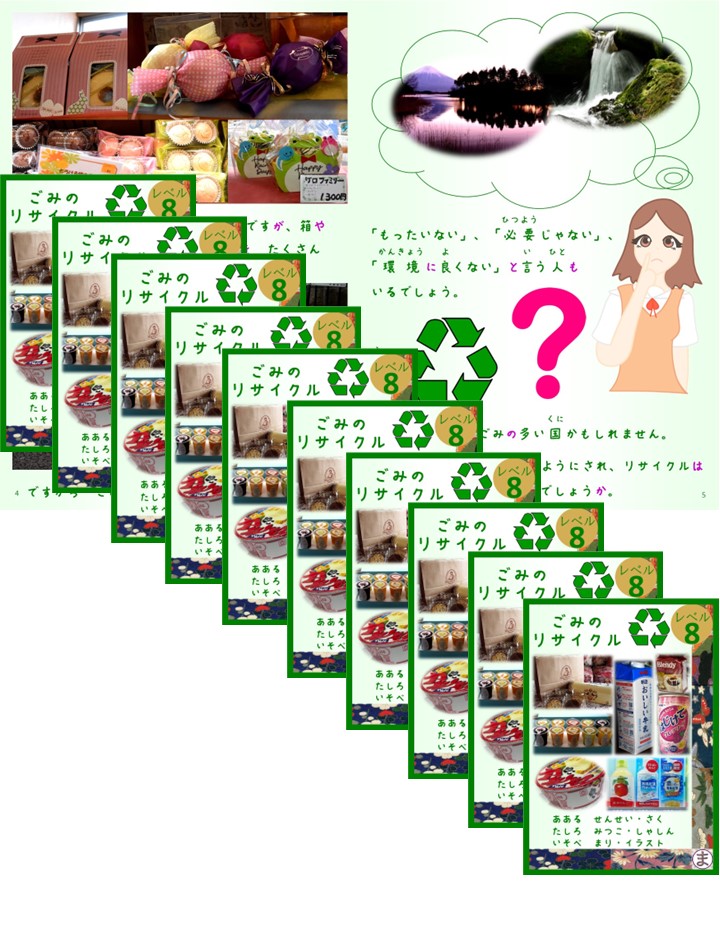
♻️ Waste Recycling (ごみのリサイクル) – Level 8 — Consolidate factual reading through Japan’s recycling practices and environmental responsibility.
🏡 Scarecrow Village (かかしむら) – Level 8 — Discover an unusual real Japanese village through authentic photographs and meaningful factual Japanese.
🏃 Sports Day (うんどうかい) – Level 8 — Strengthen connected Japanese reading through an authentic Japanese school tradition.
📚 Explore More Japanese Reader Packs
🚀 Advanced Japanese Readers Pack — Develop reading confidence through Levels 7–9 Japanese readers.
📚 All Japanese Readers Pack — Discover the complete collection of graded Japanese readers.
🖥️ Japanese Reader Class Sets & Online Flipbooks — Explore printed classroom sets with matching password-protected Online Flipbooks.
📌 Important Information
This Japanese Reader is designed for individual reading and Japanese Extensive Reading (Tadoku).
For classroom teaching, explore the Water in Japan Japanese Reader Class Set & Online Flipbook.
Copyright © Mariko Earle. All rights reserved.
No part of this publication may be copied, reproduced, or distributed without prior permission from the copyright holder.


 English
 日本語
Reviews
There are no reviews yet.